Aistake Finance: Decentralizing Stake Management

A multi-validator staking protocol on the Solana network designed to maximize capital efficiency and community-driven delegation.

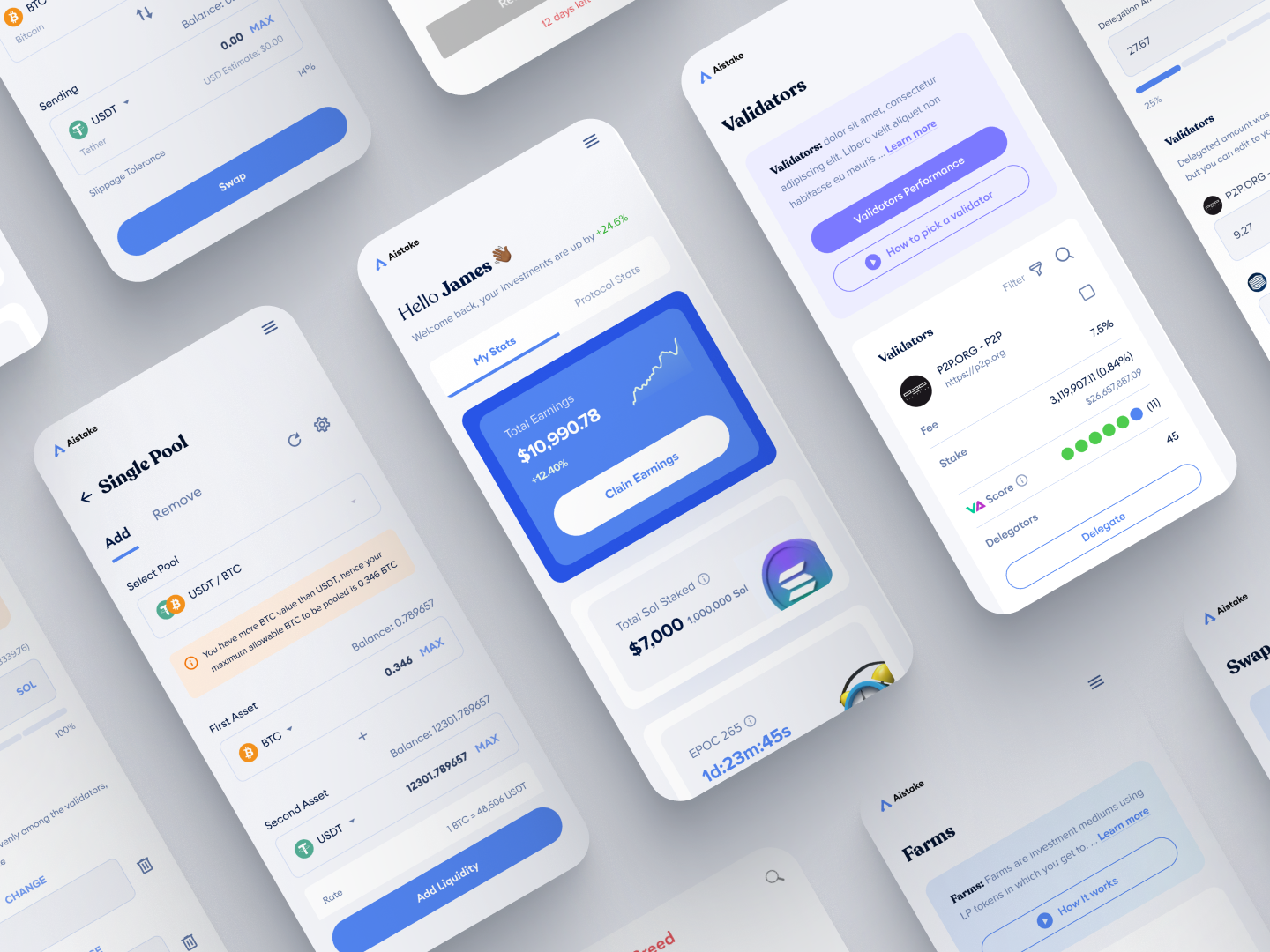
Aistake is a protocol built to enhance the decentralization of staking on the Solana. The goal is to allow users manage complex stake delegations across multiple validators simultaneously.

Aistake Finance redefines the staking experience by utilizing an Automated Market Maker (AMM) framework to provide instant liquidity for staked assets. By allowing users to delegate across multiple high-performing validators simultaneously, the protocol eliminates single points of failure and empowers the community to earn passive yield without sacrificing the ability to trade or reinvest in real-time.

Role

Product Designer

Client

Aistake

Duration

2 months

Year

2022
Quick Read
Full Case Study

Problem Statement & Research Synthesis

Through deep-dive market analysis and user interviews, I identified a critical friction point: Liquidity Paralysis. Traditional staking locks assets for 2–3 days (epochs), preventing users from reacting to market volatility or participating in DeFi. This "all-or-nothing" model forces users to sacrifice either network security or capital opportunity.

The Core Challenges & Constraints
  • The Liquidity Gap: Users like Wade want to earn rewards but fear their funds being "frozen" during sudden market shifts.
  • Validator Centralization: The complexity of picking reliable validators leads users to "set and forget" with large entities, creating single points of failure for the network.
  • Operational Friction: Navigating stake accounts, epoch boundaries, and delegation flows is technically intimidating for non-expert users.

The Dynamic Dashboard: Real-Time Performance Analytics

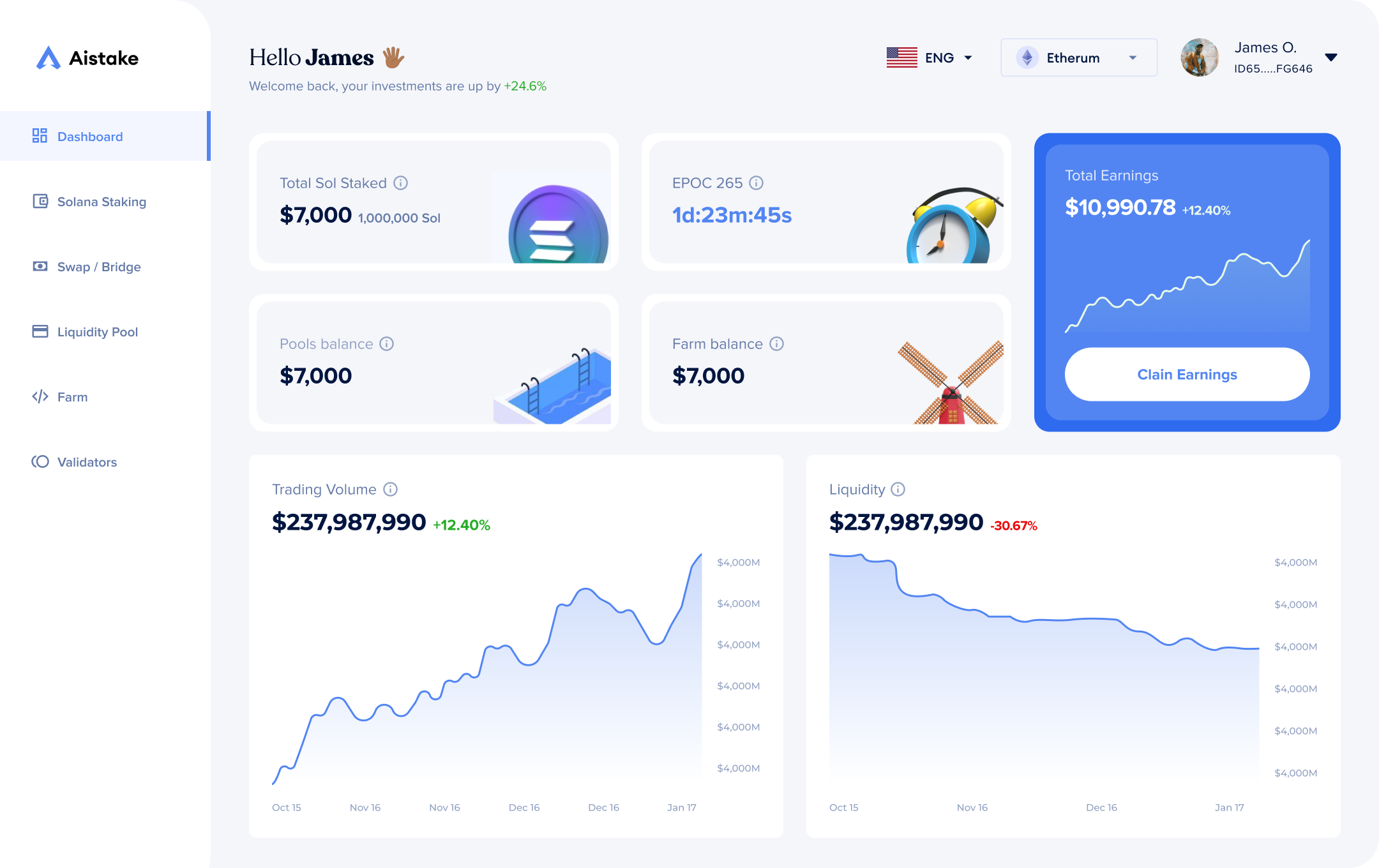
The dashboard serves as the central nervous system of the Aistake protocol, designed to provide immediate clarity. I prioritized a high-density, low-friction information architecture that surfaces critical metrics, such as total SOL staked, real-time earnings, and investment status.

By integrating volume and liquidity trends directly into the primary view, I empowered stakers to make rapid, data-driven decisions. This design moves away from abstract blockchain data toward an engaging, fintech-inspired interface that helps users visualize their wealth growth and protocol health at a glance.
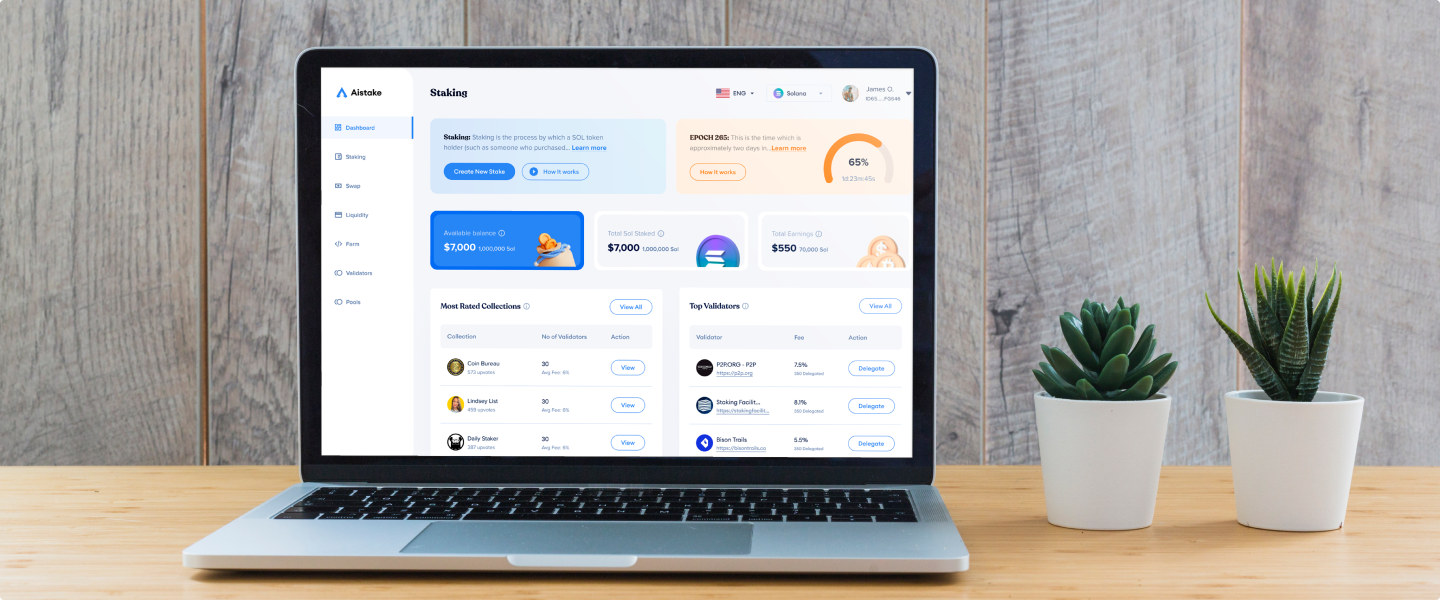
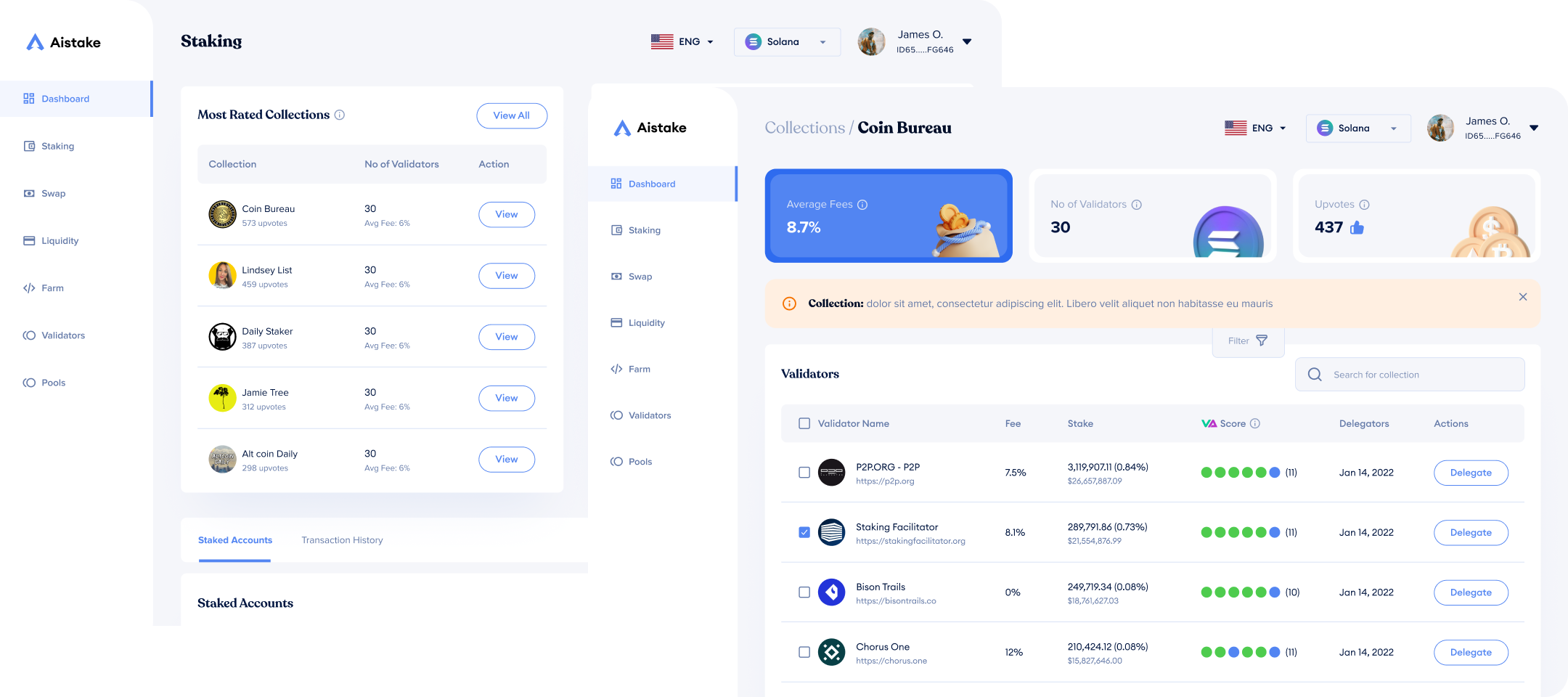
Solana Staking: Humanizing Liquid Infrastructure

Staking is often an intimidating "black box" for new users who don't understand epoch durations or delegation mechanics. I designed the staking interface as a primary value proposition, using simplified visual cues and concise explanations to guide users through the process of securing the network while maintaining asset mobility.

The interface provides granular visibility into current staking status, balance distributions, and historical withdrawal data. By including an integrated yield calculator, I allowed users to project their estimated earnings before committing capital, transforming a technical transaction into a strategic financial planning exercise.

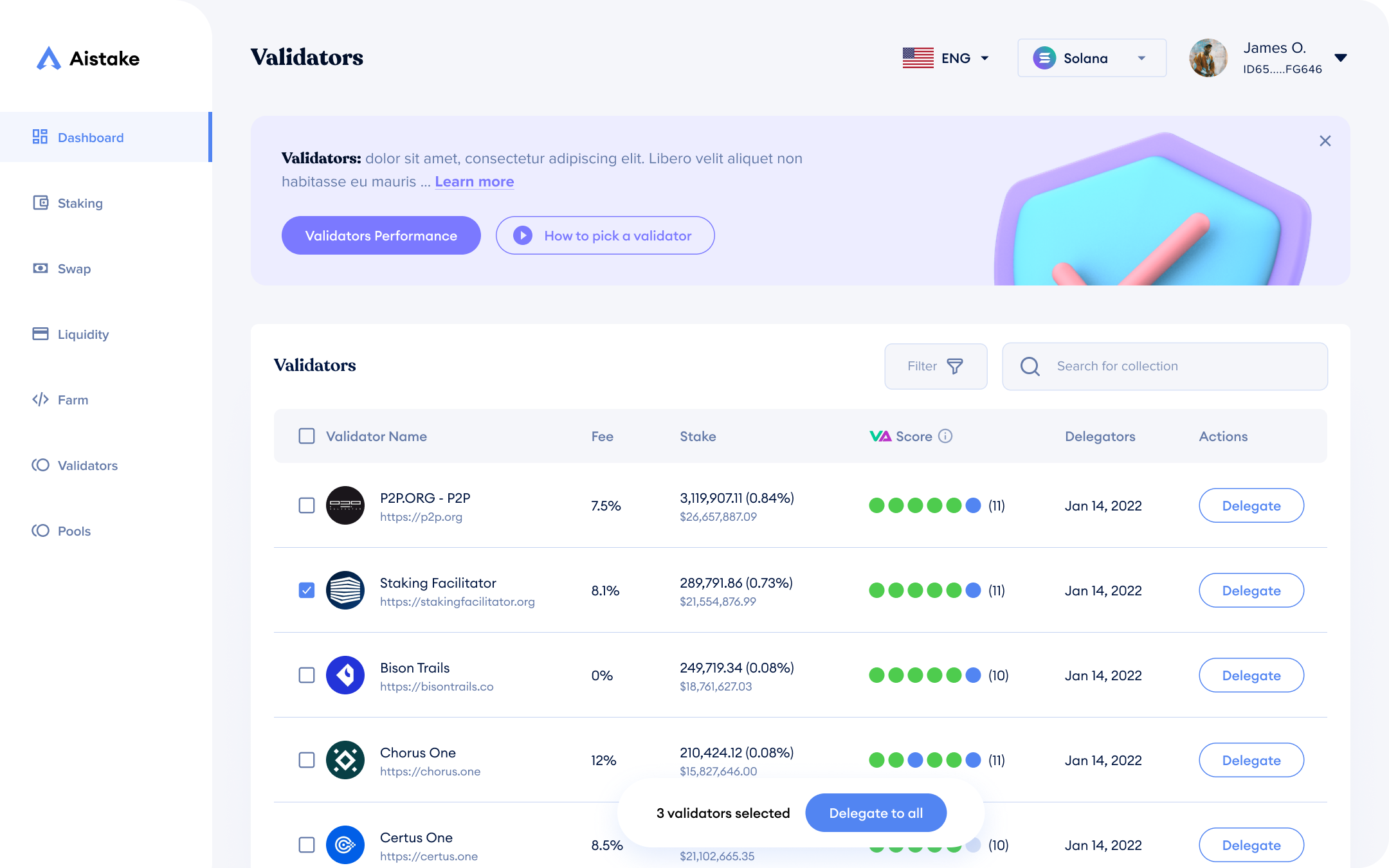
Validator Listing: Transparent Delegator Selection

The primary hurdle for stakers is knowing which validators to trust without needing advanced technical command-line knowledge. To bridge this trust gap, I designed a comprehensive Validator Marketplace that surfaces the "best and top" nodes based on uptime, fees, and community reputation.

I integrated direct links to third-party explorers for every validator, providing a layer of "social proof" and operational transparency. This design ensures that users can vet their choices with the same rigor as an ERC block explorer, replacing blind faith with verified, data-backed confidence.

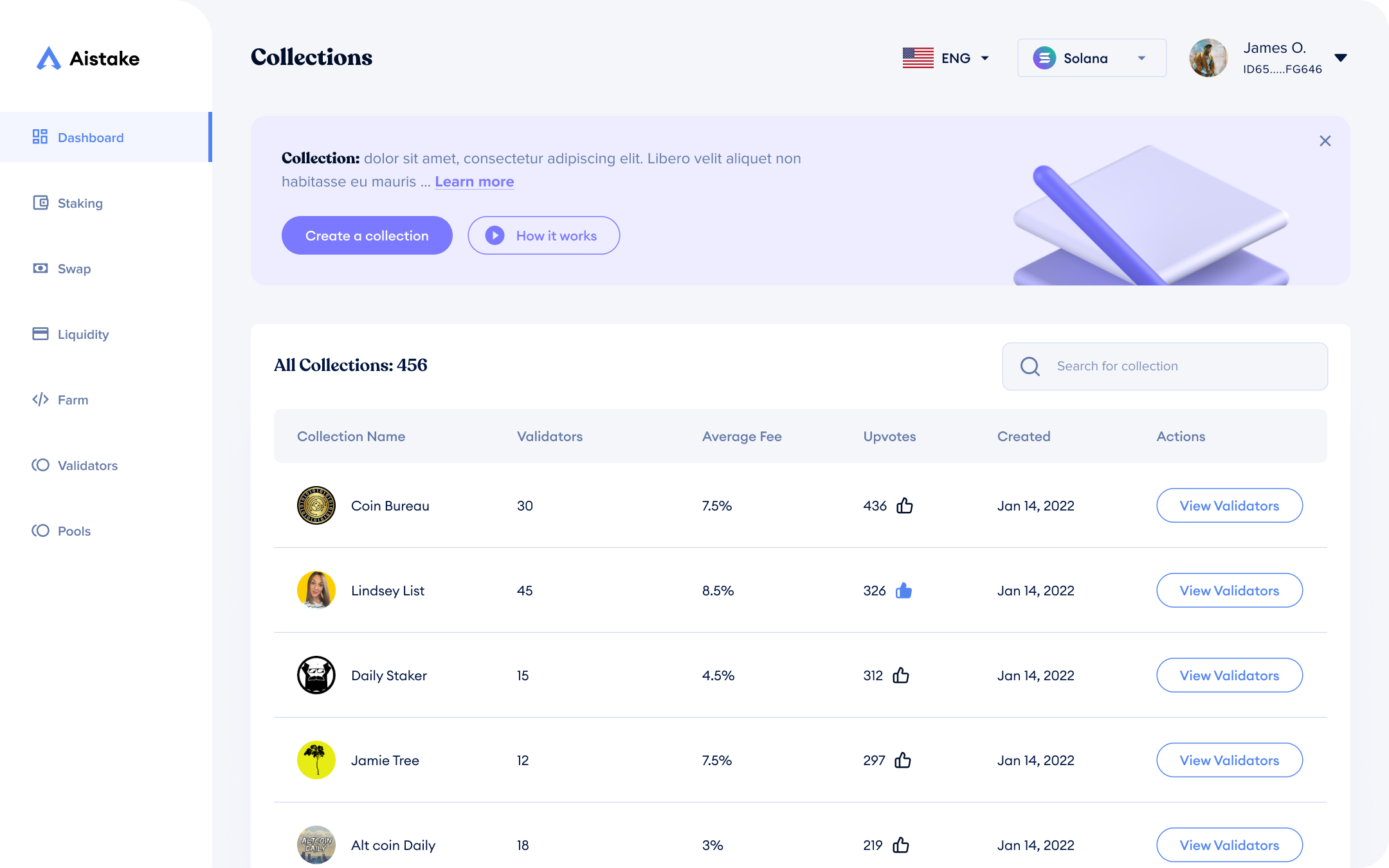
Validator Collections: Crowdsourced Risk Diversification

Leveraging the psychological principle of "Social Proof," I designed Validator Collections, a community-driven feature that allows expert users to curate sets of high-performing validators. This simplifies the delegation process for novices, who can now stake into a diversified "playlist" of nodes with a single transaction.

This feature incentivizes community participation by rewarding curators with a portion of protocol fees, creating a self-sustaining ecosystem of mutual growth. By allowing users to react to and "thumbs up" specific collections, the UI fosters a sense of collective intelligence, ensuring the best validators naturally rise to the top.

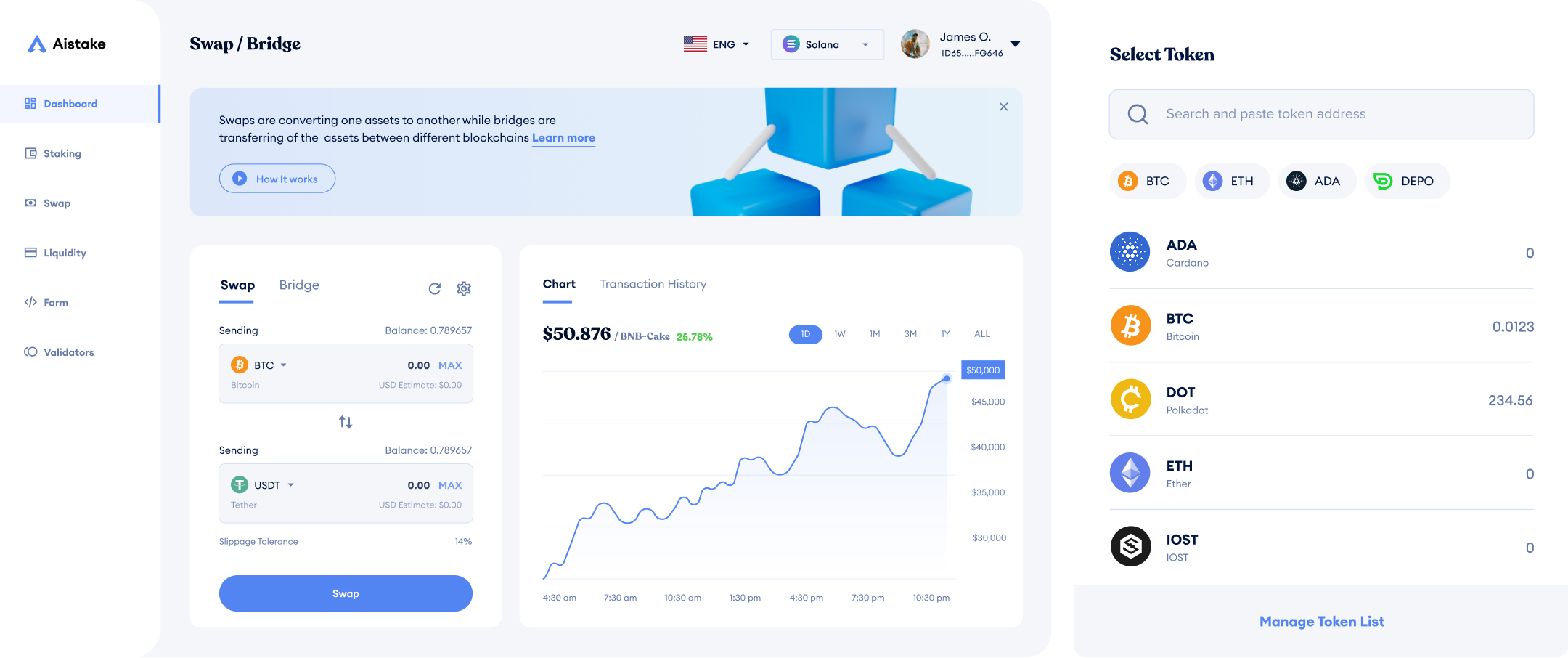
Swaps & Bridge Tokens: Seamless Cross-Chain Mobility

To maximize capital efficiency, I integrated a high-performance Swap and Bridge suite directly into the protocol. This foundational feature allows users to pivot between different assets or networks without ever leaving the Aistake environment, significantly reducing the drop-off associated with multi-platform hopping.

The design focuses on "zero-anxiety" transactions, providing clear feedback on slippage and bridging times. This serves as a vital entry and exit point for liquidity, ensuring that a user’s staked position remains a liquid, tradeable asset rather than a frozen liability.

Farming Investments: Compounding Capital Utility

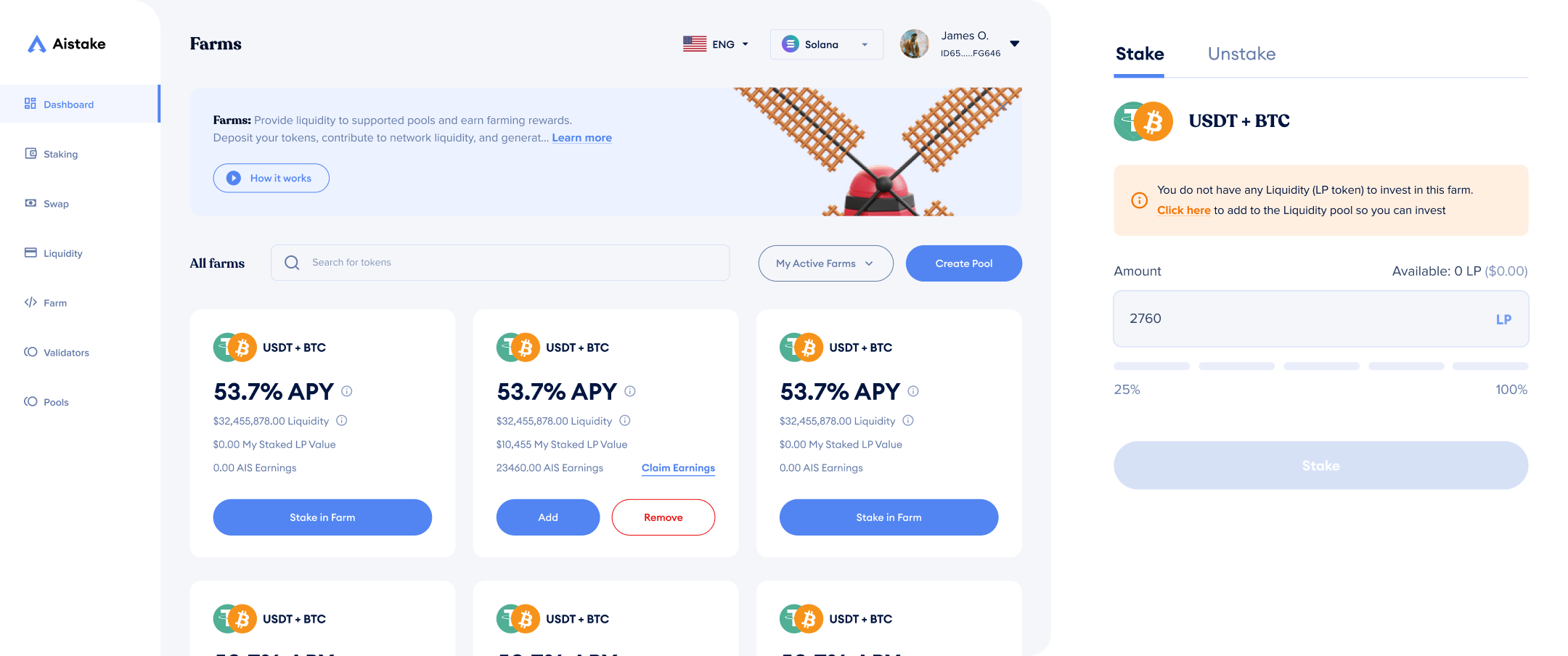
Farming allows users to earn extra yield by staking their Liquidity Pool (LP) tokens, but it often confuses users who don't understand how their "receipt tokens" work. I designed the Farming Interface to clearly display how users can earn from their pool investments.

By providing a clear receipt of the user's LP investment power, the interface helps users track their "bonus" earnings without losing sight of their core liquidity. This creates a high-retention loop where users are incentivized to keep their assets within the ecosystem to maximize their yield.

Liquidity Pools: Collaborative Yield Generation

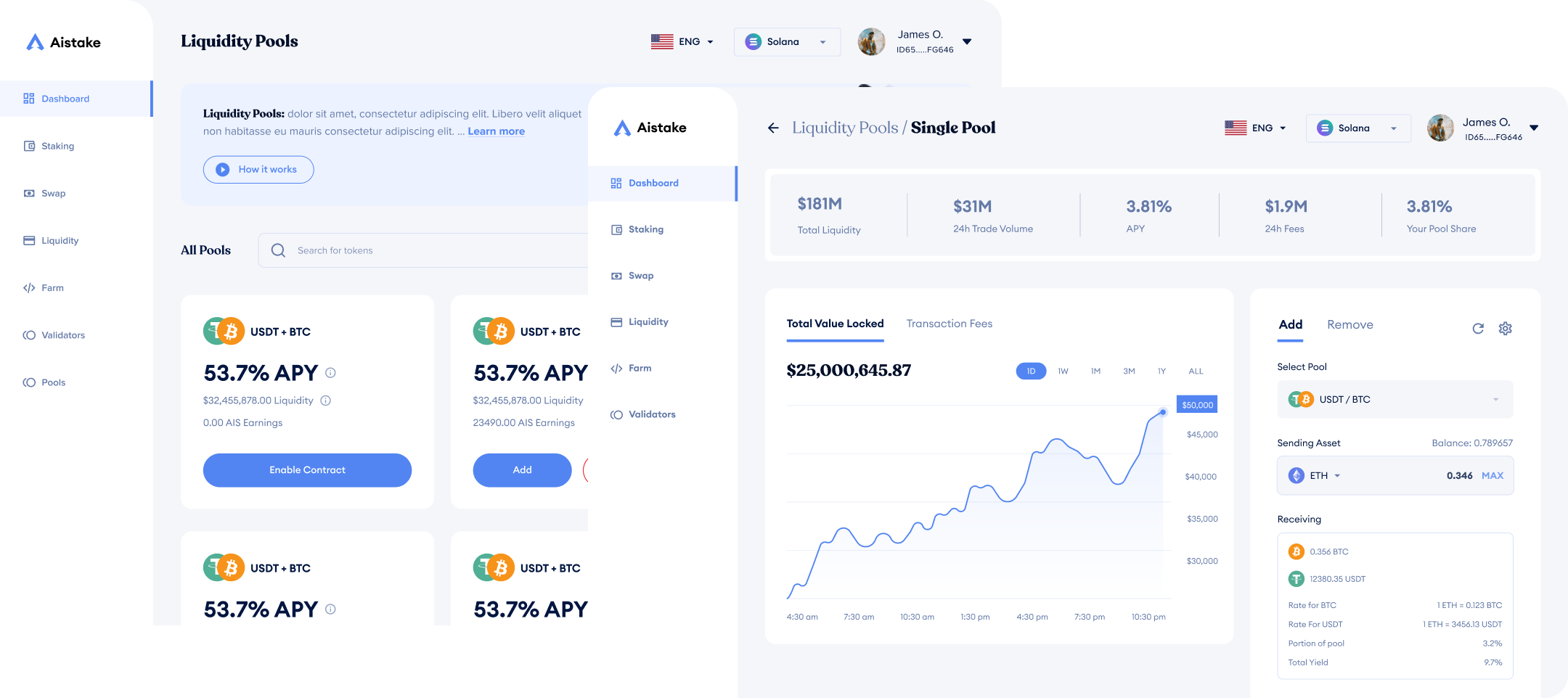
The Liquidity Pool interface was designed to allow users to participate in the protocol’s foundational market-making activities. I simplified the process of creating or joining a pool, allowing users to deposit asset pairs and earn a share of transaction fees in a few clicks.

If a specific token combination already exists, the UI automatically directs the user to the existing pool to prevent liquidity fragmentation. This proactive design choice ensures the protocol remains healthy and liquid while providing users with a simple, high-transparency pathway to becoming an LP holder.

The Problem: Confronting Capital Stagnation

Traditional staking models on Solana present a high-stakes dilemma: to secure the network and earn rewards, users must effectively "freeze" their assets. This lack of liquidity leaves investors vulnerable to market volatility, as withdrawing funds typically involves a multi-day waiting period known as an epoch. For many users, this operational friction is too high a price to pay, leading them to either avoid staking altogether or centralize their assets within high-fee exchanges that offer lower security and zero community control.

The Mission: Aistake's Mandate

The core vision for Aistake was to build a protocol where capital remains active and security remains decentralized. We aimed to create a secure medium where users could stake their SOL tokens with verified validators without losing the ability to trade or reinvest those assets in real-time.

By utilizing an Automated Market Maker (AMM) framework, our mission was to provide instant liquidity while rewarding users for identifying and supporting the network's most honest and best-performing validators. Ultimately, Aistake serves to strengthen the Solana ecosystem by distributing voting power away from malicious or underperforming nodes and putting it back into the hands of a well-informed community.

The Research & Discovery Process

To bridge the gap between complex blockchain mechanics and retail usability, I conducted an end-to-end research phase focused on deconstructing the "Staker’s Anxiety". This allowed me to identify the specific operational hurdles that prevent users from moving away from centralized exchanges.

Market Audit

I analyzed existing Solana staking platforms and competitors like Fantom to identify jargon-heavy interfaces that alienate non-expert users.

Synthesis of Friction

My research revealed that users were "locked" by fear—specifically the fear of choosing an underperforming validator or losing access to funds during market volatility.

Deductive Goals

I established a set of "Success Pillars" that prioritized one-click delegation, high-transparency validator vetting, and instant-swap liquidity.

Functional Validation

I mapped the requirement for a "Validator Trust Score," allowing users to delegate based on social and performance proof rather than manual command-line research.

User Personas

I mapped out these specific user archetypes to make sure I wasn’t just designing for "the blockchain," but for real people like Savannah and Eleanor who need to feel in control of their money without getting buried in technical jargon.

About

Savannah Nguyen is a 29-year-old District Lawyer in the united state, he is a former pro basketballer and loves cooking, he has been investing in crypto for 3 years now and is looking for a way to earn passively through staking not sure of what validators to work with

Goals

  • Savannah needs a way to stake his funds and earn passive income
  • Savannah also needs a way to have available validators for him to pick the validator to work with
  • Savannah needs a way to determine how good a validator is for him to pick

Pain Point

  • Not knowing how to identify the best validator to stake with
  • Not knowing some of the terminologies used in the other platforms he has worked with

About

Eleanor Pena is a 19-year-old dancer in Cario, Egypt, she hopes to further her studies in the UK later on. She has a few trust issues so she only invests in companies that have good social validations and reviews.

Goals

  • Eleanor needs a way to earn extra funds that she can use in saving up for her fees
  • Eleanor wants a way to convert her tokens from one asset to another especially other tokens to Solana for staking
  • Eleanor needs a way to stake with multiple validators at the same time

Pain Point

  • Most validation platforms do not have a way to swap tokens so I have to go to other protocols to swap before staking in the platform
  • She has no way of staking multiple times so she has to repeat the staking process multiple times when she wants to invest because she believes in diversification

How Might We: Asking the Right Questions

I took all the messy insights from my research and boiled them down into these specific "How Might We" challenges to make sure every design decision actually moved the needle for our users.

Value Proposition: Aligning Needs with Solutions

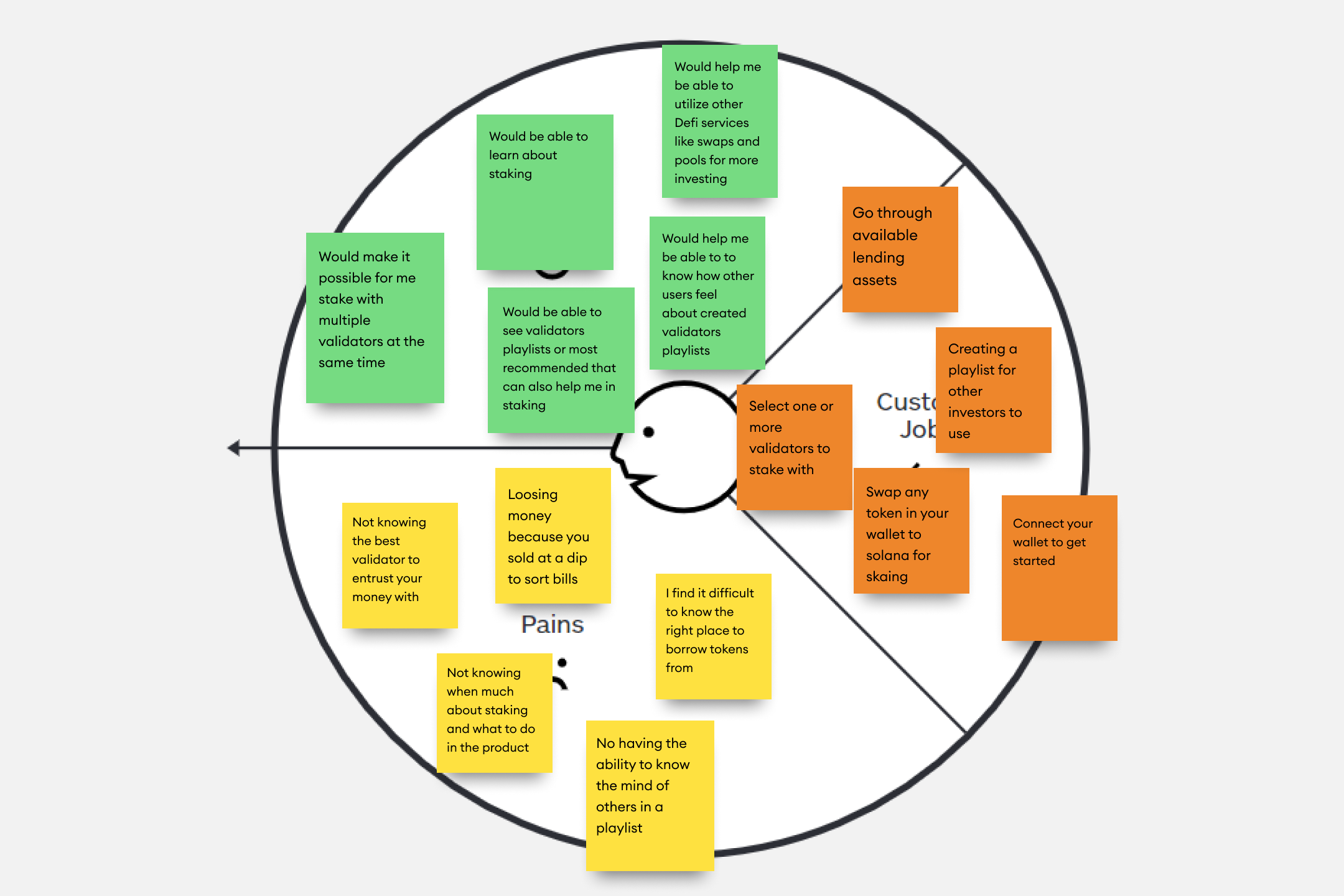
I mapped out the "give and take" of the protocol to ensure we weren't just building a tool, but creating a system where the user’s need for profit matches the network’s need for security.

User Journey Map: The Path to Confident Staking

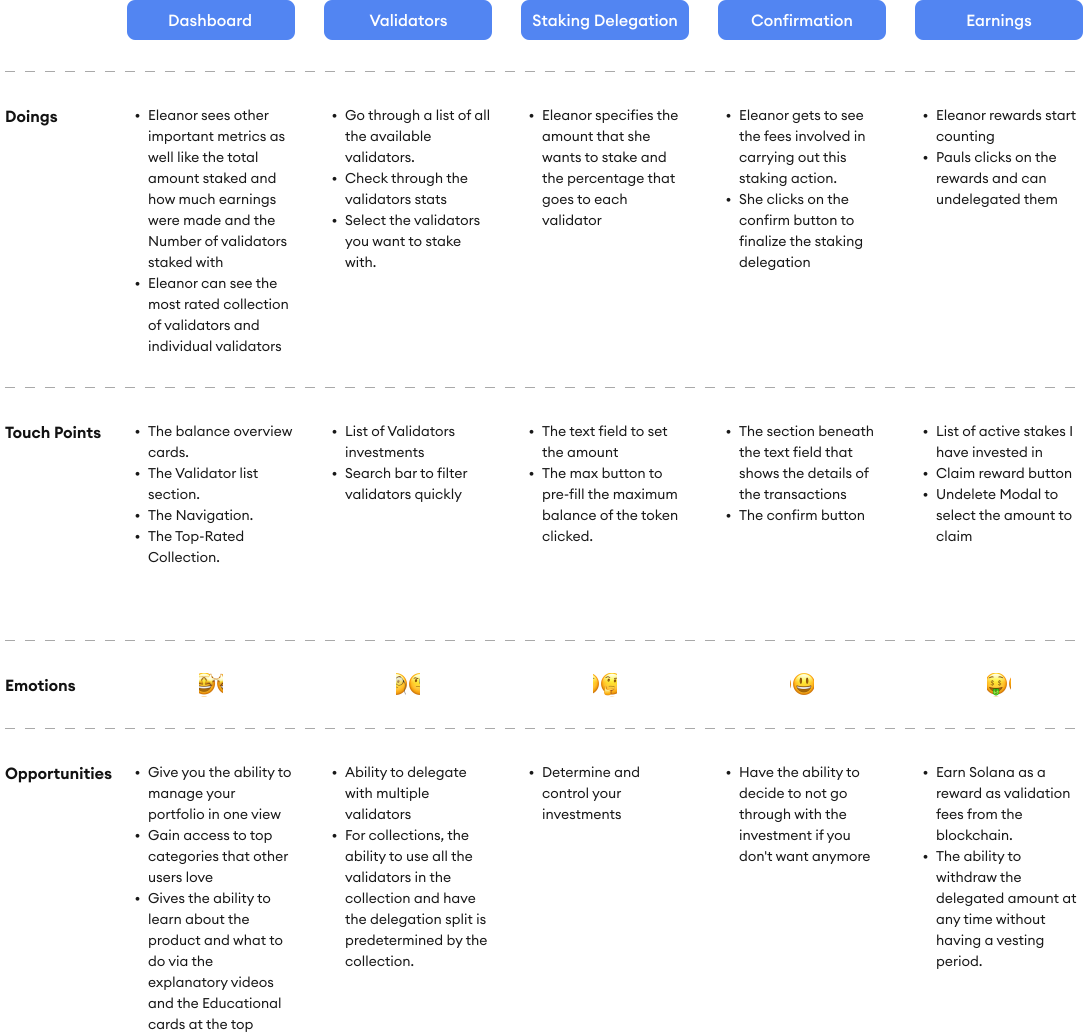
I traced the end-to-end user lifecycle, from the initial dashboard discovery to the moment rewards are earned, to ensure that navigating complex validator networks felt intuitive, transparent, and completely under the user's control.

The Dynamic Dashboard: Real-Time Performance Analytics

The dashboard serves as the central nervous system of the Aistake protocol, designed to provide immediate clarity. I prioritized a high-density, low-friction information architecture that surfaces critical metrics, such as total SOL staked, real-time earnings, and investment status.

By integrating volume and liquidity trends directly into the primary view, I empowered stakers to make rapid, data-driven decisions. This design moves away from abstract blockchain data toward an engaging, fintech-inspired interface that helps users visualize their wealth growth and protocol health at a glance.
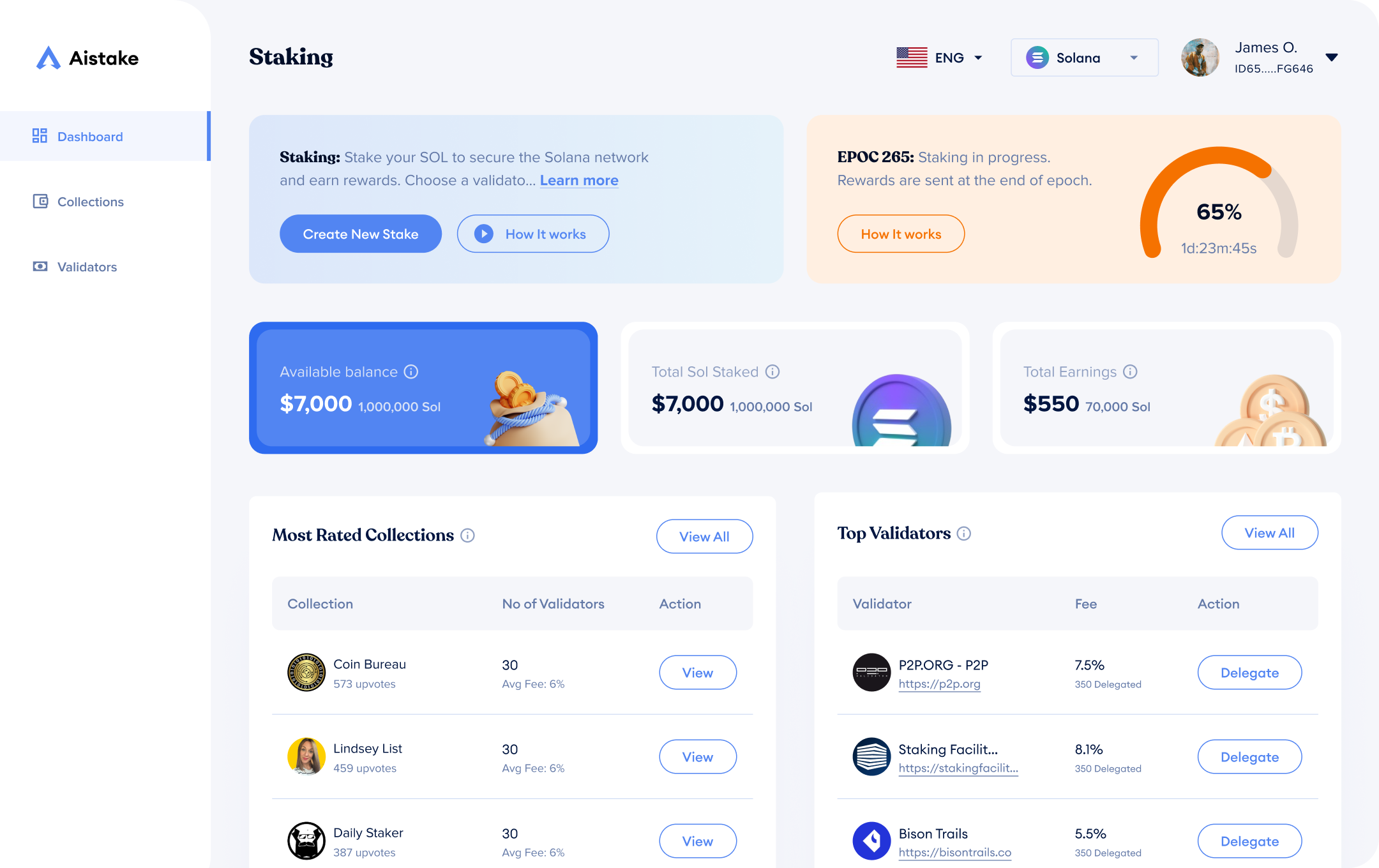
Solana Staking: Humanizing Liquid Infrastructure

Staking is often an intimidating "black box" for new users who don't understand epoch durations or delegation mechanics. I designed the staking interface as a primary value proposition, using simplified visual cues and concise explanations to guide users through the process of securing the network while maintaining asset mobility.

The interface provides granular visibility into current staking status, balance distributions, and historical withdrawal data. By including an integrated yield calculator, I allowed users to project their estimated earnings before committing capital, transforming a technical transaction into a strategic financial planning exercise.

Validator Listing: Transparent Delegator Selection

The primary hurdle for stakers is knowing which validators to trust without needing advanced technical command-line knowledge. To bridge this trust gap, I designed a comprehensive Validator Marketplace that surfaces the "best and top" nodes based on uptime, fees, and community reputation.

I integrated direct links to third-party explorers for every validator, providing a layer of "social proof" and operational transparency. This design ensures that users can vet their choices with the same rigor as an ERC block explorer, replacing blind faith with verified, data-backed confidence.

Validator Collections: Crowdsourced Risk Diversification

Leveraging the psychological principle of "Social Proof," I designed Validator Collections, a community-driven feature that allows expert users to curate sets of high-performing validators. This simplifies the delegation process for novices, who can now stake into a diversified "playlist" of nodes with a single transaction.

This feature incentivizes community participation by rewarding curators with a portion of protocol fees, creating a self-sustaining ecosystem of mutual growth. By allowing users to react to and "thumbs up" specific collections, the UI fosters a sense of collective intelligence, ensuring the best validators naturally rise to the top.

Swaps & Bridge Tokens: Seamless Cross-Chain Mobility

To maximize capital efficiency, I integrated a high-performance Swap and Bridge suite directly into the protocol. This foundational feature allows users to pivot between different assets or networks without ever leaving the Aistake environment, significantly reducing the drop-off associated with multi-platform hopping.

The design focuses on "zero-anxiety" transactions, providing clear feedback on slippage and bridging times. This serves as a vital entry and exit point for liquidity, ensuring that a user’s staked position remains a liquid, tradeable asset rather than a frozen liability.

Liquidity Pools: Collaborative Yield Generation

The Liquidity Pool interface was designed to allow users to participate in the protocol’s foundational market-making activities. I simplified the process of creating or joining a pool, allowing users to deposit asset pairs and earn a share of transaction fees in a few clicks.

If a specific token combination already exists, the UI automatically directs the user to the existing pool to prevent liquidity fragmentation. This proactive design choice ensures the protocol remains healthy and liquid while providing users with a simple, high-transparency pathway to becoming an LP holder.

Mobile Designs: Built for the Pocket, Not Just the Screen

I treated the mobile version as a "Financial Command Center." In DeFi, the market doesn't wait for you to get back to your desk. If a validator goes down or a price swings, you need to act now. My goal was to make sure the user felt just as powerful on a 6-inch screen as they do on a 30-inch monitor.

Key Takeaways

Clarity is equal to Security: In Web3, the interface is the trust. If a user doesn't understand "Slashing" or "Epochs," they won't use the product. By humanizing these terms, we didn't just make it "pretty"—we made it usable for the next wave of investors.

Systems Over Screens: This wasn't just about drawing boxes; it was about building a Scalable System. Every component was designed to grow. Whether Aistake has 10 validators or 1,000, the UI won't break, and the user won't get lost.

Being the User’s Guardian: Adding things like "Trust Scores" and "Safety Alerts" shifted the app from a tool to a partner. It reminded me that as a designer, my job is to look out for the person on the other side of the glass, especially when their hard-earned money is on the line.

Other Works

Hit me up let's create something, fun, magical, a
digital solutions that would truly relate to the users and take
the business to the next level

LETS TALK - LETS BUILD LETS TALK - LETS BUILD LETS TALK - LETS BUILD